



Click to view the news
October, 2025
Leading through action: How Assan Alüminyum is redefining sustainability in aluminium Production
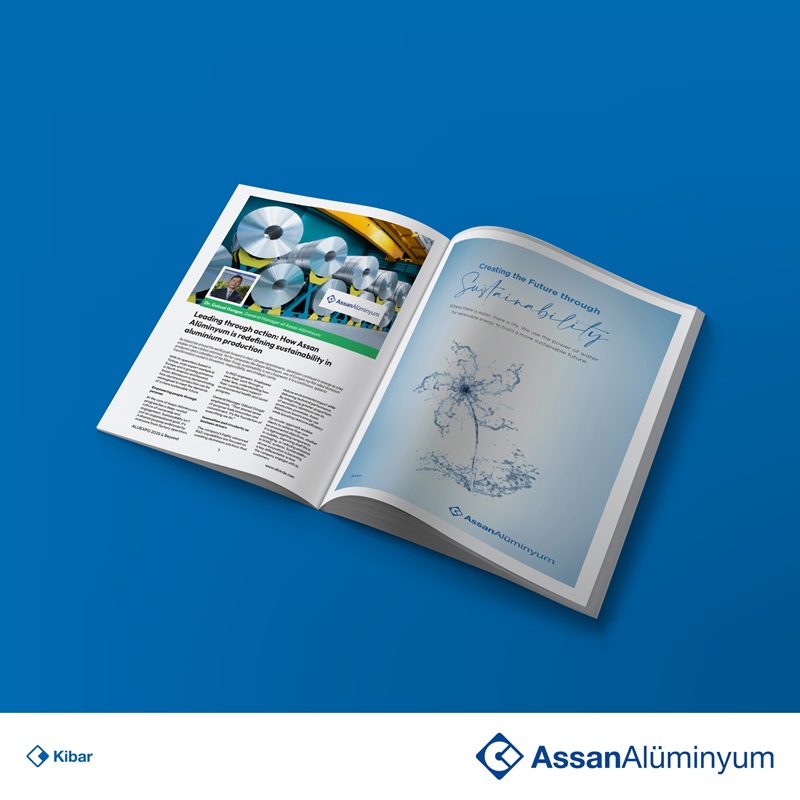
As industries around the world push forward in their climate commitments, aluminium continues to emerge as a key enabler of low-carbon solutions. Yet for companies like Assan Alüminyum, one of Europe’s top flat rolled aluminium producers and a subsidiary of the Kibar Group, sustainability is not a buzzword. It is a continuous, systemic transformation rooted in innovation, responsibility, and strategic clarity.
With its operations based in Türkiye, main export markets in Europe and a growing presence in North America and beyond, Assan Alüminyum is demonstrating how aluminium production can be reimagined to meet the demands of a more sustainable future.
Empowering people through purpose
At the core of Assan Alüminyum’s progress lies a deep-rooted culture of ownership and engagement. Sustainability isn’t just an organisational goal, it’s a shared purpose embraced by everyone from factory operators to R&D engineers. Employees view their work through a wider lens, understanding how their contributions support environmental health and social progress.
General Manager Göksal Güngör emphasises, “That shared sense of purpose fuels innovation and commitment. It’s the foundation of everything we do.”
Innovation and circularity as business drivers
The company’s highly advanced R&D capabilities are focused on creating aluminium solutions that reduce environmental impact while delivering technical performance. By integrating greater proportions of secondary aluminium into its production processes, Assan Alüminyum lowers energy use while boosting resource efficiency.
Its circular approach enables clients to achieve their own environmental objectives, whether it is lightweighting components in mobility, improving shelf life in packaging, or reducing emissions in HVAC systems. Sustainability-driven innovation is becoming a key differentiator in how the company engages with its customers.
Extending impact across global supply chains
Assan Alüminyum recognises that its environmental footprint extends beyond its own operations. Through the K-STAR Supplier Sustainability Program, led by parent company Kibar Group, the company actively engages its upstream partners to evaluate and improve their social and environmental performance. Spanning thousands of suppliers across dozens of countries, this program encourages widespread adoption of more responsible practices across the value chain.
In North America, Kibar Americas, Assan Alüminyum’s wholly owned subsidiary, plays a vital role in delivering sustainable and high-quality aluminium solutions, mainly to the US market. This regional presence allows the company to align more closely with customer needs and market regulations, while maintaining the high environmental standards applied at its global operations.
Real-world recognition and financial backing
Assan Alüminyum’s sustainability leadership has not gone unnoticed. The International Finance Corporation (IFC), a member of the World Bank Group, awarded the company a USD 90 million green loan to support low-carbon technologies and infrastructure development. This endorsement underscores the credibility and seriousness of its decarbonisation strategy.
The company also received Aluminium Stewardship Initiative (ASI) Performance Standard certification, validating its operations against internationally recognised ESG criteria. With a score of “B” received from the CDP climate change programme, above industry averages, Assan Alüminyum is setting a benchmark in transparency and climate risk management.
Clean energy as a cornerstone
One of the most powerful enablers of decarbonisation at Assan Alüminyum is its investment in renewable energy. The company operates both hydroelectric and solar power plants, and uses International Renewable Energy Certificates (IRECs) to fully offset its Scope 2 emissions. This approach not only lowers market-based emissions but ensures compliance with evolving regulatory frameworks and customer expectations.
“Renewable energy is a strategic advantage,” notes Güngör. “It helps us stay competitive, resilient, and aligned with the values of our stakeholders.”
A clear roadmap to net-zero
The company has defined ambitious but actionable carbon reduction goals: lowering carbon intensity to 7 tCO₂e/t by 2030, halving that to 3 tCO₂e/t by 2035, and achieving full carbon neutrality by 2050. Its decarbonization roadmap is grounded in data, investment, and consistent execution. With clear goals and strategies, Assan Alüminyum has made sustainability an integrated, enterprise-wide focus.
Investing in nature and community
Beyond climate strategy, Assan Alüminyum demonstrates environmental and social responsibility through long-term projects that connect industry to nature and community. In partnership with Kocaeli University’s Biology Department, the company launched a Biodiversity Preservation Project back in 2019. The project initially aimed at protecting the endangered Blue Star plant, then proceeded with the propagation of various native species such as the Sea Daffodil, the Riva Mullein and recently the Kilyos Button, ultimately contributing to regional ecosystem health.
The company’s Art at the Factory initiative bridges the worlds of manufacturing and creativity by purchasing and displaying student artworks in its production facilities. This not only supports young artists’ educations but also creates a more inspiring work environment. Meanwhile, its afforestation efforts, including planting over 30,000 trees and gifting tree planting certificates to its stakeholders, instead of traditional gifts, highlight how sustainability can become a part of everyday business culture.
A call for industry-wide collaboration
As aluminium continues to shape the future of sustainable development, Assan Alüminyum stands ready to lead, and to partner. Whether through technical innovation, low-carbon production, or supplier engagement, the company’s mission is clear: to create lasting value by advancing sustainability at every level of the aluminium supply chain.
“True progress happens when we act together,” concludes Güngör. “Our values—reliability, flexibility, innovation, and sustainability— guide us forward, and we invite others to walk this path with us.”
Other News
October, 2025
Our Decarbonisation Roadmap is the Compass Guiding us Toward Carbon Neutrality By 2050
September, 2025
Assan Alüminyum’s Roadmap for a Greener Future
July, 2025
Shaping the future of sustainable aluminium
July, 2025
Assan Alüminyums ökologisches und soziales Engagement
May, 2025
Driving sustainability in the global aluminium industry